Infrastructure, Environmental, and Sustainability Engineering Sector
Download
Case Study
Client background
The hundred year old PE backed engineering firm is a long-standing leader in coastal and offshoreengineering, known for tackling some of the world’s most complex environmental and infrastructurechallenges. Its geoscience teams collect and interpret sub-bottom seismic (SEG-Y) and relatedocean-floor datasets to map key geologic features that inform permitting, engineering design,environmental compliance, and risk assessment.


The firm provides engineering, construction, environmental, sustainability, resilience, andinfrastructure solutions to government agencies as well as commercial, industrial, and energy clients.Over more than a century, it has delivered tens of thousands of projects globally—spanning oil andgas, industrial facilities, coastal infrastructure, environmental restoration, and disaster-response—andhas made continuous reinvention a defining part of its DNA: “After 104 years, we’re just gettingstarted.”


With a workforce numbering in the thousands and offices across North America, the firm brings deepexpertise in geotechnical and marine engineering, infrastructure asset management, and large-scalesubsurface surveys for energy and offshore exploration sectors.Given the growing complexity and scale of ocean-floor and sub-bottom datasets, encompassingseismic acquisition, geologic interpretation, and risk modeling, the manual process of labeling andclassifying geologic features had become a critical throughput bottleneck under private equityownership, directly impacting speed, margins, and scalability.
The problem
Manual labeling of complex ocean‐floor datasets required teams of PhD geologists up to six months per project.
Additional Constraints
 Label variability & noise: Some feature picks were faint or inconsistently visible (e.g., channels that appeared only sporadically), creating ambiguity for both humans and machines.
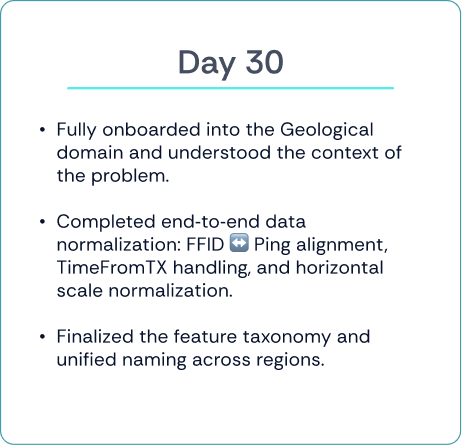
Heterogeneous nomenclature: Equivalent features carried different names across regions (e.g., Valley vs. Valley Fill; Seafloor_ASC vs. Seafloor), complicating training and QA. SEG‑Y/CSV alignment: Feature CSVs and SEG‑Y traces used different primary keys. Reliable alignment required matching FFID ↔ Ping (not simple trace indices) and honoring polyline continuity rules across gaps.
Time/depth semantics: Picks were stored as two way travel time; horizontal exaggeration and display scaling made visual QA error prone without normalization. Geodesy differences by region: Surveys spanned multiple NAD83 State Plane zones in US survey feet, with negative source/group scalars in SEG‑Y headers, each requiring precise conversion to WGS84 Lat/Lon for mapping and downstream tools.
Operational integration: The solution had to export predictions into the client’s workflow (e.g., SonarWiz polyline CSV) and import cleanly on seismic images, with no off‑ramp to “demo‑only” artifacts.
Speed to value: As a PE backed business, the firm needed a defensible MVP fast, showing measurable throughput and margin impact with minimal lift from already stretched geoscience teams.
What We Did
Discovery & Label Sourcing
• Partnered with the client’s geoscience leads to enumerate high‐value features for sub‐bottom interpretation: Seafloor, Ravinement Surface (RavSurface), Texas Mud Blanket (TMB), Valley/Valley Fill, Northern/Southern Delta Lobes, Laminated Muds, Faults, Channels, Gas.
• Organized a three‐tier feature taxonomy by continuity, aligning model difficulty with geologic expression:
          1. Continuous: Seafloor, RavSurface, TMB (present across entire lines).
          2. Semi‐continuous: Valley Fill, Northern/Southern Delta Lobes, Laminated Muds.
          3. Sparse/episodic: Faults, Channels, Gas, etc.
• Codified polyline continuity rules: gaps between clicks should render as a single continuous line unless a new header segment denotes a distinct feature.
Data Standardization & Alignment
• Established a deterministic join between SEG‐Y and feature CSVs using FFID ↔ Ping (page‐accurate alignment), superseding fragile trace‐index heuristics.
• Normalized two‐way travel time (TimeFromTX) and corrected horizontal exaggeration to ensure apples‐to‐apples visualization during QA.
• Built a geodesy layer: honored coordinate_units = feet, applied source/group scalars (e.g., /100), and mapped SOU_X/SOU_Y (or GRP_X/GRP_Y) to WGS84 using the correct NAD83 State Plane zone per region (e.g., TX South vs. South Central, FL North, LA South, AL West, NC statewide).
• Unified naming conventions (e.g., Valley ⇢ Valley Fill) and reconciled region‐specific CSV
• variants (e.g., Seafloor_ASC = Seafloor).
Modeling & Architecture
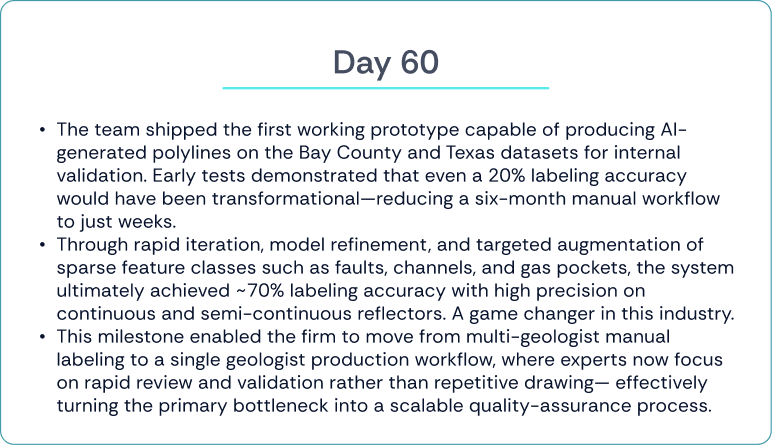
• Built a specialized AI model trained to detect and label geologic reflectors and geomorphic features (faults, channels, delta lobes, etc.) directly from sub‐bottom profiles.
• Designed feature‐aware training guided by the continuity taxonomy: prioritized high‐signal continuous reflectors for rapid gains; introduced semi‐continuous and sparse classes with targeted augmentation to address class imbalance.
• Implemented polyline reconstruction to convert per‐trace predictions into continuous, geologically plausible lines that respect the client’s continuity rules.
• Exposed confidence scores and source citations (Ping/FFID + TimeFromTX) to support review, audit, and active‐learning loops.
Quality, Evaluation & Human‐in‐the‐Loop
• Built per‐feature evaluation harnesses (continuous vs. sparse classes assessed with different metrics and tolerances).
• Flagged low‐confidence spans for targeted human review and rapid relabeling—tightening the feedback loop without broad geologist time sinks.
• Created validation checks to catch mis‐scaled displays, out‐of‐CRS coordinates, or mis‐joined lines before model training.
Pilot, Integration & Rollout
• Delivered SonarWiz‐compatible CSV exports of AI‐predicted polylines. Initial imports revealed coordinate/CRS mismatches; we corrected scalars and CRS mapping so predictions plotted precisely on seismic images and in map view.
• Provided a lightweight run‐book: CRS selection by region, field mapping, import steps, and a labeling QA checklist.
• Enabled a single‐geologist review workflow: accept/edit AI polylines, push back to the training set, and re‐export—all within the client’s existing tool chain.
The XTAM team weren’t geologists, but they learned our world faster than anyone we’ve ever worked with. They came into a 106-year-old business, understood a hyper-specific domain, and completely changed how we operate.

By the time they walked out of the room, they were operating at the level of the top geologists in the industry.

— CTO of the 106 year old Engineering Firm

”
The Results
Companies We’ve Built
Why XTAM