The AI Adoption Lifecycle
This AI adoption lifecycle framework helps leaders identify where their organization stands today, anticipate the next set of challenges, and chart a deliberate path forward. Executives often overestimate their AI maturity or view their struggles in isolation, when in reality they may be experiencing the natural growing pains of AI maturity progression.
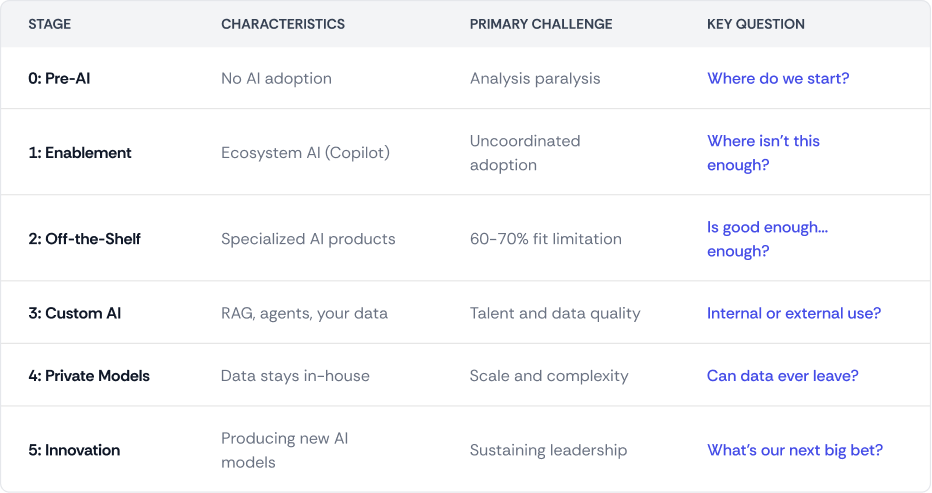
By understanding the common stages—from having no AI capabilities to leveraging AI for full-scale innovation—you can set realistic expectations and make informed decisions about investments and strategy at each step. As you read through each stage, consider where your organization currently sits, and where you want to go next.
Pre-AI (Awareness & Exploration)
This is the starting point. Your organization has no active AI deployments in its products, services, or internal processes. Leaders and staff are likely aware of AI's growing prominence but have not yet implemented any solutions. Often, there's a "wait and see" approach or uncertainty about how to begin.

Signs You're at This Stage
No formal AI initiative exists within the organization
Employees aren't using AI assistants in their daily work
AI feels like something other companies are doing
There may be "shadow AI" usage—employees quietly experimenting without guidance
∙ Fit limitations: Generic tools can't accommodate your unique processes or terminology
∙ Integration complexity: Multiple point solutions create a fragmented AI landscape
∙ Data silos: Each tool may require its own data setup, preventing unified insights
∙ Is 60-70% alignment enough, or do you need solutions that match your business at 90%+?
∙ Which one or two strategic use cases merit official support and investment?
∙ Do you have the internal expertise to build custom, or do you need to develop it?
The Goal: Move from "should we use AI?" toward "let's try something small"—building confidence and organizational buy-in.
This is where most organizations begin their formal AI journey. You've enabled AI assistants within your existing technology ecosystem—Microsoft Copilot, Google Workspace AI, or coding assistants. Adoption is often driven by enthusiastic middle managers or tech-savvy employees rather than top-down strategy.
Signs You're at This Stage
Your team uses Copilot or similar assistants for day-to-day tasks
Developers have AI coding assistants in their IDEs
Individual employees are experimenting with AI in their personal workflows
AI is helpful but feels generic—it's not tailored to your specific business
Tracking Success: Metrics that Matter
Adoption vs. ROI Velocity
Comparing user adoption rates with business value generation
∙ Uncoordinated adoption: Different teams adopt AI tools independently, leading to duplicate efforts
∙ Data privacy concerns: Employees might feed sensitive data into free AI services not realizing the exposure risk
∙ ROI measurement: Successes are anecdotal, and failures might go undetected
∙ Governance gap: Without alignment, budgets can be spent on overlapping tools
∙ Should you formalize and organize AI efforts, or let them continue organically?
∙ What basic governance and policies for AI use should be established?
∙ Which AI tools should be officially approved (enterprise versions vs. free public versions)?
∙ Should you create an AI task force or center of excellence to coordinate efforts?
Ask: Where is general-purpose AI not enough for your specific needs?
Off-the-Shelf AI Products
Organizations at this stage purchase specialized AI products for specific functions (e.g., legal contract analysis, sales prospect research). These solutions are ready-made, affordable, and quick to deploy, covering 60-70% of common use cases.
The Reality
What you're buying is affordability and speed to deployment. Off-the-shelf products are always cheaper because they're built generically enough to cover a breadth of situations—but not necessarily the depth of your current situation. That same generality means the tool will never perfectly match your specific workflows, terminology, or data structures.
Signs You're at This Stage
You've purchased one or more specialized AI tools
Tools work well for common scenarios but struggle with edge cases
You feel like you're paying for capabilities you don't need while missing ones you do
The match between what you bought and what you need is about 60-70%
∙ Fit limitations: Generic tools can't accommodate your unique processes or terminology
∙ Integration complexity: Multiple point solutions create a fragmented AI landscape
∙ Data silos: Each tool may require its own data setup, preventing unified insights
∙ Is 60-70% alignment enough, or do you need solutions that match your business at 90%+?
∙ Which one or two strategic use cases merit official support and investment?
∙ Do you have the internal expertise to build custom, or do you need to develop it?
Ask: To get above 90% fit, you need to build custom. Are you ready for that investment?
To break past the 70% ceiling, organizations begin building custom AI (RAG systems, AI agents) trained on their own data. Adoption shifts to an organized initiative with executive sponsorship, budgets, and governance.
Signs You're at This Stage
You've built (or are building) AI systems trained on your own data
Your AI can retrieve company-specific documents and information
You're thinking about whether this AI is for internal productivity or external use
Questions about intellectual property and ownership are becoming relevant
Data quality, infrastructure investment, talent gaps, cultural resistance, and ROI pressure.
Prioritization of projects, Build vs. Buy analysis, Governance frameworks, and Operating models.
Ask: To get above 90% fit, you need to build custom. Are you ready for that investment?
The philosophy becomes: "AI comes to us." Rather than sending data out, you bring AI in-house. Companies build or finely customize AI models using proprietary data, treating AI as mission-critical infrastructure.
Signs You're at This Stage
You've identified use cases where general-purpose models fall short
Data privacy and security are non-negotiable—your data cannot leave your environment
You're exploring or deploying models that run entirely within your infrastructure
AI is embedded across multiple core processes
Complexity management, Reliability requirements, Ethical stakes, Model maintenance.
Integration scope, Productization, Innovation investment, Leadership structure.
Ask: Can your data ever leave your environment? If not, AI must come to you.
The pinnacle of maturity. AI is woven into the company's DNA. Organizations develop proprietary AI models and IP, setting them apart in the market and informing strategic decisions at all levels.
Signs You're at This Stage
You have dedicated AI research and development resources
Your organization is producing new AI models, not just adapting existing ones
AI innovation is part of your strategic roadmap
You offer AI solutions to other companies or shape industry best practices
Sustaining innovation, Pioneer blind spots, Regulatory attention, Ecosystem alignment.
Where to direct innovation?, Monetization, Collaboration vs. competition, Culture and succession.
Ask: How does AI become not just a tool, but your competitive edge and a source of new revenue?
Planning the Way Forward
Once you know your current stage, plan deliberately. This means defining what capabilities, resources, and governance you need to move to the next stage of maturity.
.png)
∙ Fit limitations: Generic tools can't accommodate your unique processes or terminology
∙ Integration complexity: Multiple point solutions create a fragmented AI landscape
∙ Data silos: Each tool may require its own data setup, preventing unified insights
∙ Is 60-70% alignment enough, or do you need solutions that match your business at 90%+?
∙ Which one or two strategic use cases merit official support and investment?
∙ Do you have the internal expertise to build custom, or do you need to develop it?
Whether you're just beginning or refining advanced AI systems, XTAM can help you evaluate your stage and build a practical roadmap.

.png)

.png)
.png)